
|
|
|
|
#1
 09-08-13, 07:55
|
|||
|
|||

Dan,
I agree with Grant: the engine is the Auxiliary Generator engine - a Morris 4 cylinder side valve model USNMH Mk2 or Mk2/1. These assemblies required frequent changing in service. The tank is not equipped with an armoured rear fuel tank, hence the infantry phone is still mounted on the rear louvre plate. Might this be a later Mk.7 hull? The spare road wheel is mounted on the same plate, hanging from the tow rope link mount: not unusual, as the carriage of spare roadwheels was not part of the original stowage design, but found to be necessary, hence the position varies quite a bit between units/vehicles. The 'strange' item between the side bins appears to be one of the engine deck covers, raised and leaning against the side of the turret between the bins. It is hard to see for sure. Mike C 
|
|
#2
09-08-13, 09:10
|
||||
|
||||
|
Back in the 70s
Wneh I was working at Hughes Auto Spares I recall a batch of new Ford 10 sidevalve motors which I was told were to do with Centurions. Did we substitute those in Australia?
They sold like hotcakes to guys with Prefects and early Anglias.
__________________
Film maker 42 FGT No8 (Aust) remains 42 FGT No9 (Aust) 42 F15 Keith Webb Macleod, Victoria Australia Also Canadian Military Pattern Vehicles group on Facebook https://www.facebook.com/groups/canadianmilitarypattern
|
|
#3
09-08-13, 11:30
|
||||
|
||||
|
Victorian test
Hi Guys
Here is a photo I took of a Centurion that I am sure would be recognizable to MLU members in Victoria. Sorry no prize for a correct answer. The Centurion at Coomandook South Australia on the Dukes Highway is about an hours drive towards the Victorian Border form me.  Cheers Tony 
__________________
Anthony (Tony) VAN RHODA. Strathalbyn. South Australia
|
|
#5
09-08-13, 15:44
|
||||
|
||||
|
A hint
Quote:
Bob Mosley and I used to stop and stare at the COOMANDOOK Centurion on our border raids into Victoria. There is no way in hell the guy who owns the one I photographed would part ever with it. HINT to the location. Bob and I collected my MB Willys Jeep from there. HINT HINT.  Cheers Tony
__________________
Anthony (Tony) VAN RHODA. Strathalbyn. South Australia
|
|
#6
09-08-13, 17:03
|
|||
|
|||
|
Keith, as far as I'm aware, the Ford 10 was not used in the Cent as a replacement.
I think the Coomandook Cent is 169042: it has quite a history. Don't know the ARN of the one in your images, Tony. Dan: scratch my comment about a Mk.7: it's a Mk.5 or 5/1 hull with 'crap' hanging off the air outlet louvre plate. 'Phone is in the normal position. Mike C
|
|
#7
10-08-13, 02:22
|
||||
|
||||
|
Close up
Quote:
I have had a close look at the ARN number but can't read them all. I have done some close up shots so maybe this may assist you make it out. Cheers Tony
__________________
Anthony (Tony) VAN RHODA. Strathalbyn. South Australia
|
|
#8
10-08-13, 15:37
|
|||
|
|||
|
Hi Mike and gents, Its the oil cooler standing between the turret bins, They hinge at the front
Kind regards
|
|
#9
10-08-13, 21:05
|
|||
|
|||
|
Matt,
Yes, of course it is! My error.... It also well illustrates why there are several reports of damage to oil coolers by rotating the turret without first checking that all was clear. In all cases, the offending 'rotator' was charged with 'negligence: member to pay' - an expensive lapse of concentration for a lowly Trooper. Thanks, Matt: just shows that 'hand on' experience is priceless. Mike C PS: The feature article in MMI this coming issue is about the Australian Centurion Driver Training Tank, and Tim Vibert's example in particular.
|
|
#10
11-08-13, 03:34
|
||||
|
||||
|
Quote:
I'm sure that you knew exactly what you meant when you wrote 'they hinge at the front.' Unfortunately my knowledge of the vehicle is not as great and I have to admit that I'm not really sure what you meant by your description. Below is a photograph of the rear deck of a standard Centurion. Using this as a frame of reference, was the oil cooler under one of those things on the rear deck between the turret and the engine cover? Are they some kind of access hatches? Did the hatches rotate forward or just come straight off? Did the oil cooler lift straight out, or rotate up on a hinge? Any information that you can provide would be greatly appreciated. Cheers, Dan 
|
|
#11
11-08-13, 03:55
|
||||
|
||||
|
Oil Cooler
Matt,
I think I've answered my own question. Below is a photograph of the cutaway Centurion tank at the museum in Bovington. From this angle the oil cooler, painted silver, with its front hinge can be clearly seen, as can the engine. Still curious about the what everything is on the rear deck of the vehicle. Cheers, Dan. 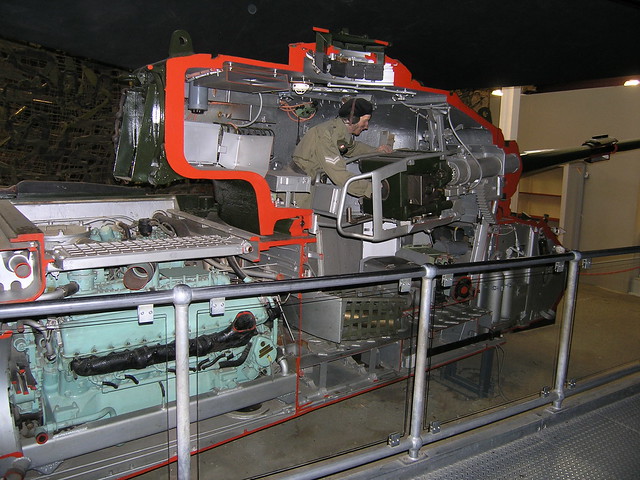
|
|
#12
11-08-13, 04:05
|
|||
|
|||
|
Dan,
The rear deck of a Cent consists of two sets of hinged covers: the forward set of five interlocking covers are the engine compartment covers, the rear set are the transmission covers. Both sets must be lifted in the correct sequence (different for each set). The engine compartment covers hinge at the rear, and are lifted from the front, ie closest to the turret, hinging backwards over the transmission covers. The turret must be positioned in the correct part of the traverse for each engine cover in turn to be lifted. (The transmission covers hinge forwards, and are rested against the side of the turret when open). The oil cooler is below the engine covers, slightly right of the Meteor engine centerline. It is hinged at the front, ie nearest the turret, to allow it to be rotated clear for access to other parts of the engine peripherals, but does not require disconnection from the oil lines (which connect at each side of the pivot point or 'hinge'). It pivots in an arc upwards, and as the image shows, can be lent against the turret between the bins if the turret is in the correct position. Mike C
|
|
#13
11-08-13, 04:25
|
||||
|
||||
|
Engine and Transmission Covers
Mike,
This time I think I'm finally starting to get a hang of everything you've been trying to tell me. I took the earlier photograph of the tanks on the train and cropped it down to just the rear deck of the last vehicle. I can see the five engine (forward) and five transmission (rear) covers quite clearly. All rotating on the same single hinge. Just so that I'm clear in my mind, the engine covers and the transmission covers can't be opened for maintenance at the same time, and for each individual engine cover to be opened the turret must be made to rotate a few degrees. If I'm right, what a pain in the butt this vehicle must have been. Cheers, Dan 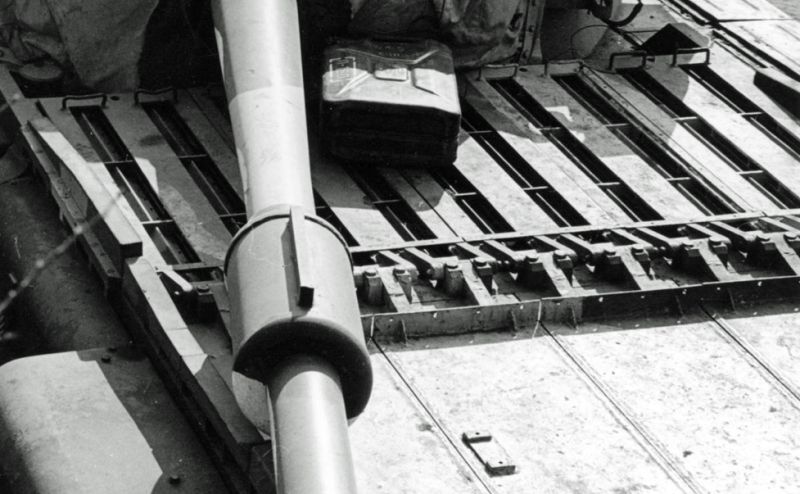
|
|
#14
11-08-13, 12:09
|
|||
|
|||
|
Hi Dan and Mike
To lift both sets,The radiator covers are opened first then the radiators are opened, the louvers then rest back on the radaitors, the engine covers are then lifted and lay against the rear set thus giving access to both sides. Kind Regards Forgot to mention that with the turret rotated to the left, you remove both turret bins and all the louvers can be opened at once(in order of cause).
|
|
#15
11-08-13, 17:46
|
|||
|
|||
|
Yes, however, removing the two turret bins was a tedious process, as they mounted on studs with nuts and washers. I think the Canadians et al all left theirs in that original configuration, and continued to lift the covers in sequence by rotating the turret, as per the manual.
Whereas Australia devised a modification that mounted the bins on steel straps attached to the back of each bin, and held to the turret by u shaped pieces - the straps slid into the u shaped pieces that were welded to the turret in place of the studs. The bins could be lifted clear of the turret quickly by a couple of the crew - I think your Cent has that mod, Matt? Makes bin removal and cover-lifting a whole lot simpler. Mike C
|
 |
| Thread Tools | |
| Display Modes | |
|
|


 Hybrid Mode
